
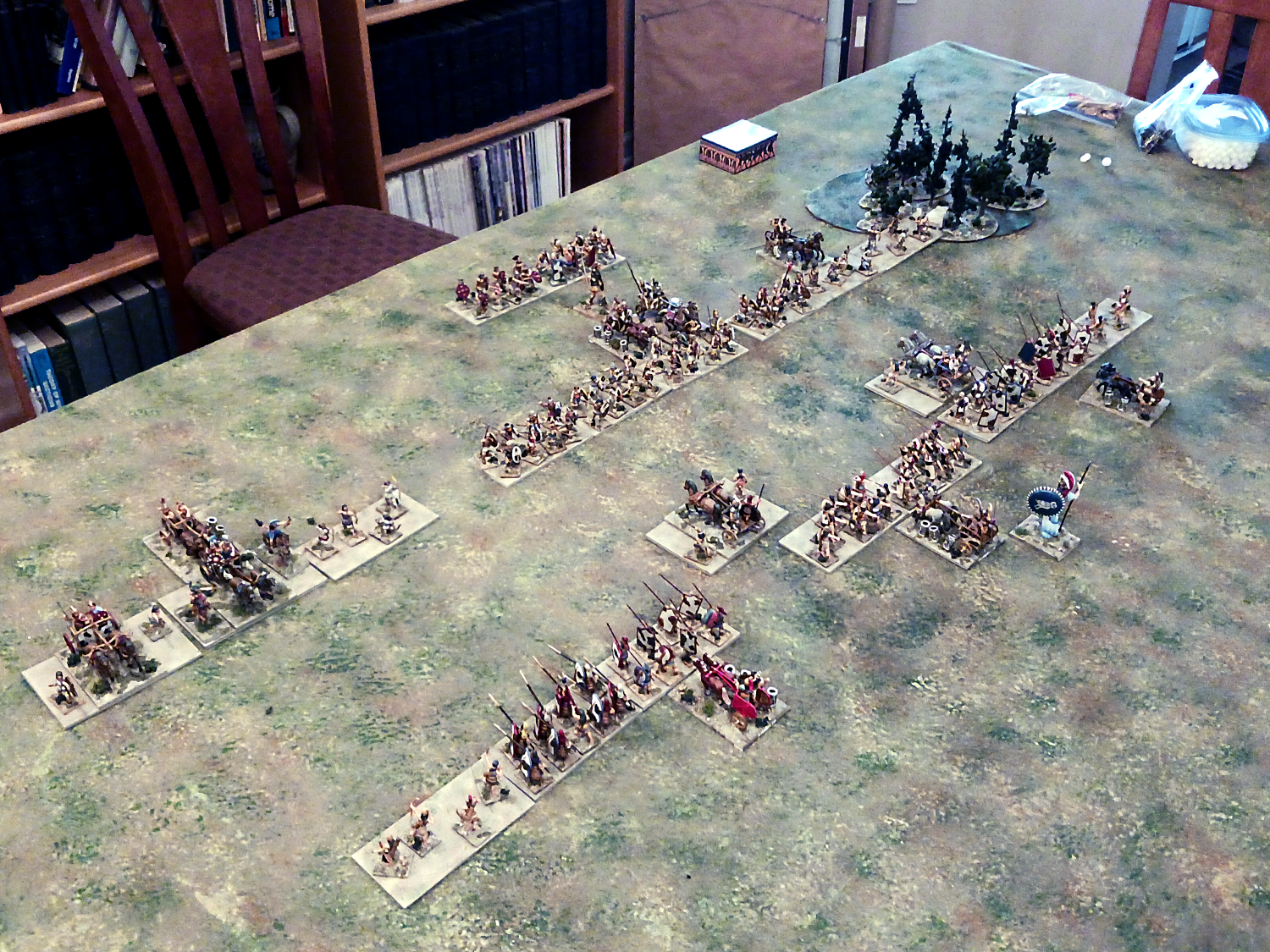
After a few weeks of summer delay we played our first game of Midgard using the ‘Battle’ scenario and the Trojan and Greeks army lists as published in the rules. We diced for sides, Athena, er, Rob commanded the Greeks and chose to be the attacker. I took the Trojan defenders and set up first positioning two light archers and a spear unit commanded by Sarpedon on my left flank anchored on a clump of woods. Hector, seconded by Polydamus commanded the center of all spearmen and finally two chariot units and an archer commanded by Aneas were positioned on the right.
Athena, er, Rob adopted a more symmetrical deployment with bowmen on either flank, warriors strung out between. Two units of chariots were posted forward of the main line. Achilles commanded the left and joined the chariot force on that side. Diomedes commanded the center leaving Patroclus commanding the right.


Wanting to get right into the action we chose to forego the initial personal challenge and went straight to the attacker’s first move. Athena, er, Rob made a general advance but a few of his units balked and refused to enact a second movement phase. Ares, er, I also chose to advance but only enough to get my bowmen on my left into the woods thus anchoring my flank more securely.
The first actions took place on the Trojan left when the Greek bowmen advanced into range and traded shots with the Trojan archers in the woods. This was mostly inconsequential. Then the action got rather fast and deadly. The Trojan chariots on the right made a thunderous charge against the Greek lights who evaded into the woods behind them. Hector led the Trojan center into battle with the Greek spear men under Achilles command. Having expended his mighty deeds to force the troops forward, Hector chose not to challenge Achilles. Even so, the gods mightily favored the Trojans in this exchange and the warriors surrounding Achilles dissipated like dew in the morning sun leaving the hero, wounded, surrounded by Hector and his fighting men.


While things looked favorable for the Trojans, Achilles’ Myrmidons saw their proud demigod in trouble and surged forward and to their right to protect him. Once reinforced, Achilles roared a challenge to Hector and slew him with a mighty thrust leaving him ‘as food for rav--er, dogs’. It helped him naught. Hector’s warriors, though defeated by the Myrmidons and forced to retreat, managed to inflict hits and dealt a second wound to Achilles, slaying him. The Myrmidons stood their ground.
Fortune swung back to the Trojans whose chariots managed to chase down and destroy the Greek archers of Achilles' command who where sheltering in the woods. Aneas joined the second Trojan chariot unit and charged into action against the Greek spear men in an attempt to further weaken the Greek left flank. Meanwhile, in the center, Polydamus drove additional warriors forward to support the retreating spear men of Hector’s contingent. A general melee ensued as both sides threw in more units. Slowly the Greeks were forcing the Trojan center back into line with the Trojan left led by Sarpedon. On the Trojan left the advantage in numbers favored the Trojans as they concentrated fire on the Greek archers and sent them to Hades. Yet, the cry in the Trojan center was, “Where are the Lycians? Where are they?” *


No offense to Athena, but Attrition is the Queen of Battle. Attrition decreed that victory, though narrow, would go to the Trojans when they finally eliminated the bowman guarding the Greek right flank. Perhaps an inglorious victory obtained by eliminating peasants with bows but such was the will of the Fates. The final count of Reputation was -4 for the Greeks to 0 for the Trojans.


There are a lot of things I like about these rules and nothing really stuck out as a negative. At this point there are lots and lots of blog entries and videos that cover the mechanics and describe the ebb and flow of the game. No reason to rehash all that here.
Now, it’s been several weeks since I read the rules and Rob admitted that he’d only watched a couple of videos. Still, the rules are straight forward enough that we got up to speed quick enough to avoid getting frustrated. I’m not entirely sure we did everything correctly (in fact, I know we didn't!*) I constantly forget to take advantage of trait benefits! There was a fair amount of thumbing through the rule book—but that’s inevitable when playing a new set of rules. It took us about two hours to play three or four turns which brought the game to a clear conclusion. That left plenty of time for the traditional back-and-forth about how the game played.
So what were the deciding factors of the game? Ultimately, I think it was the aggressive actions the Trojans were able to enact at the beginning of the game. (Though, the dice gods were certainly favoring my rolls—I’m sure I’ll pay the price for that for the next six months!) Making contact first and charging with the Army Commander (Hector) provided me a reserve of Reputation above what the Greeks had. While Hector’s death in the duel was a massive blow to my Reputation, since I had that reserve his death was less consequential than Achilles’.
Single combats are high risk. And we’re both wondering if there is any reason to hold back any available Mighty Deeds on the first round of combat when involved in single combat. Seems to me that there is a real advantage to front loading that first roll to try and get a quick kill by surpassing the enemy’s armor value.
Because there were a few situations that need clarification, I reset the game for a solo replay but was only able to get through three turns before needing to disassemble the table which I had set up in the dining room. At that point both sides had lost a unit of bowmen but I think the Achaeans were slightly ahead. The Trojans were down to 6 Reputation, the Achaeans were at 7. But... the Trojans had been able to extract two more Stamina from the Greeks than they themselves had lost. Admittedly, I had forgotten to award Reputation points for some of the initial contacts which probably would have favored the Greeks. I think turn four or five would have decided the battle!

Questions:
1) Do heroes in secondary fighting units add their combat dice? Answer: I'm pretty sure they do. Since the secondary unit can receive overflow hits and the heroes have to check for wounds I see no reason why they should not be participants of secondary combat.
2) Does the killing zone of a unit partially contacted on the front extend forward from the uncontacted portion of the front of the Unit? Answer: No. (p. 13) “A unit’s killing zone no longer applies to other enemy units if the unit is engaged in combat.”
Meanwhile, in the shipyard:
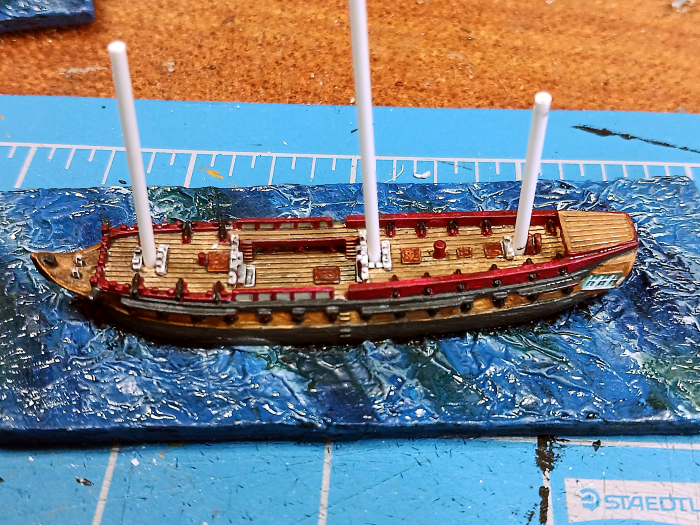
Both versions of the Virginie have been painted and based and are now having their masts stepped. I just received word this morning that my next four 3rd-rate ship models have been shipped. :-D

[* The missing Lycians (Lukkans!) were left in the storage drawers--they didn't even make it onto the table for the first game! Ooops!]
Powered by Bestatic | © Copyright Jeffery S. Koppe | CC-BY-SA 4.0 License.